

Introduction: The Shift to Cloud-First in Atlassian
The digital workplace is evolving faster than ever. For most organizations, the question is no longer “Should we move to the cloud?” but “How do we use the cloud to fundamentally improve how teams work?” Nowhere is this shift more visible than in the Atlassian ecosystem.
Atlassian’s cloud-first strategy isn’t simply a migration of Jira, Confluence, or Jira Service Management. It represents a deeper transformation toward cloud-native collaboration — where work is automated, integrated, intelligent, and globally accessible in real time.
The cloud isn’t the destination.
It’s the foundation for new ways of working.
Why Cloud-First?
Cloud platforms are no longer just infrastructure choices, they’re workflow accelerators. Organizations adopting Atlassian Cloud gain:
- Scalability without Limits: Teams and projects can grow instantly, without provisioning servers or upgrading hardware.
- Enterprise-Grade Security and Compliance: Atlassian Cloud includes built-in security controls, continuous monitoring, and automatic updates — capabilities that are expensive to replicate on-prem.
- Deep, Native Integrations: Cloud-first APIs connect Atlassian products with Slack, Teams, Google Workspace, Salesforce, and hundreds of marketplace apps.
- Cost Efficiency & Predictability: A pay-as-you-grow model replaces unpredictable maintenance costs with transparent operational spend.
- AI as a Collaboration Force Multiplier: According to Atlassian’s State of AI in Service Management 2024 report, 88% of organizations already use AI in service management, signaling that AI-assisted collaboration has become mainstream, not experimental.
This shift sets the stage for cloud-native workflows that go far beyond simply moving workloads off-premise.
Beyond Migration: The Evolution to Cloud-Native Collaboration
Most organizations start with migration — but the real value comes after teams begin working in new ways. Cloud-native workflows in the Atlassian ecosystem bring:
- Real-time collaboration across globally distributed teams in Confluence and Jira.
- Automated workflows powered by Jira Automation and Atlassian Intelligence.
- Unified insights thanks to cross-product data accessibility and smart search.
- AI-driven assistance that summarizes content, drafts responses, and predicts next actions.
Here’s how the industry differentiates cloud adoption from cloud-native transformation:
| Aspect | Cloud Adoption | Cloud-Native |
|---|---|---|
| Focus | Lift-and-shift migration | Re-architecting workflows for cloud |
| Integration | Basic app connectivity | Deep, API-driven automation |
| User Experience | Similar to on-prem | Real-time, intelligent, collaborative |
| Scalability | Constrained by legacy design | Fully elastic, multi-region |
This shift is where collaboration becomes faster, smarter, and more aligned with modern digital operations.
Business Impact: Cost Savings, Efficiency, and Lower Risk
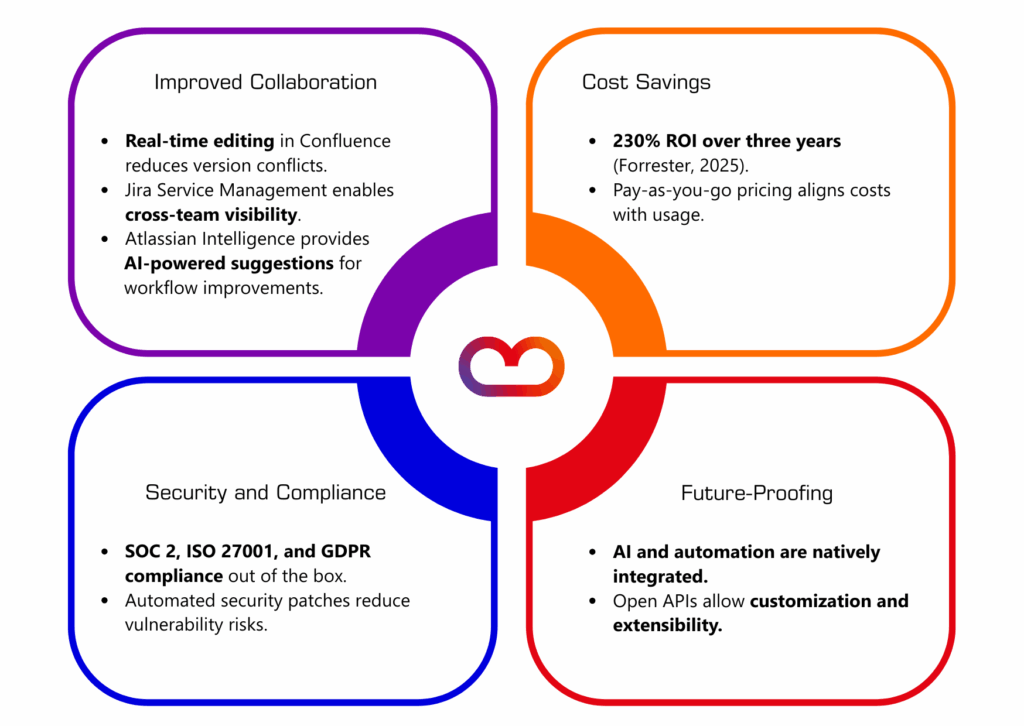
Forrester’s Total Economic Impact™ of Atlassian Cloud Enterprise (2025) found:
- 230% ROI over three years
- Significant reduction in tool administration
- 35% fewer security incidents or escalations
- Faster deployment of new features and innovation
These gains come not just from moving infrastructure to the cloud, but from adopting cloud-native collaboration patterns that optimize work across engineering, product, service, and business teams.
Challenges and How Organizations Overcome Them
A cloud-first strategy brings enormous potential, but also real challenges:
1. Complex Migrations
Legacy workflows, custom configurations, and historical data structures can slow transitions.
Solution: Atlassian’s Migration Program and ecosystem partners provide tooling, planning frameworks, and automated migration paths.
2. User Resistance to New Ways of Working
Teams accustomed to on-premise tools may struggle with new features or behaviors.
Solution: Structured change management, in-product guidance, and focused training help teams unlock the benefits of cloud-native features.
3. Integration with Non-Atlassian Systems
Custom legacy systems aren’t always cloud-ready.
Solution: Atlassian’s API-first architecture and marketplace ecosystem enable seamless, scalable integrations.
Organizations that proactively address these challenges see much faster adoption and higher ROI.
Future Trends: AI, Automation, and Global Scalability
Agentic AI Becomes Standard. Atlassian Intelligence increasingly acts as a collaborative teammate, generating summaries, suggesting actions, and automating routine tasks. This reduces administrative work and speeds up decision cycles.
Automation Without Barriers. With low-code/no-code automation in Jira and Confluence, entire workflows can be redesigned in minutes. Non-technical teams — HR, finance, marketing — can now automate processes previously dependent on IT.
Global Scale, Local Performance. Atlassian continues to expand multi-region hosting and data residency options, enabling:
- Lower latency
- Compliance with regional regulations
- Reliable access for distributed teams
Cloud-native platforms are evolving toward near-instant responsiveness, even for geographically dispersed organizations.
Cloud-First Is the New Normal. Cloud-Native Is the New Advantage
The Atlassian ecosystem is not simply moving to the cloud.
It is evolving into a cloud-native collaboration platform that enables teams to work in real time, supported by AI, automation, and globally scalable infrastructure.
Organizations that adopt cloud-native thinking, not just cloud migration, achieve:
- Faster innovation
- Stronger security and resilience
- More integrated workflows
- Higher productivity
- Better cross-team alignment
The future of teamwork is cloud-native, intelligent, and seamlessly interconnected.
Next Steps for Your Organization
To begin or accelerate your journey:
- Assess your current workflows and identify where cloud-native features (automation, AI, integrations) can deliver the highest impact.
- Use Atlassian’s migration tools and partners for a structured, low-risk transition.
- Train and empower your teams to use new AI and automation capabilities.
- Continuously measure and optimize using data to make decisions.
Cloud-first is no longer just an IT strategy; it’s a collaboration strategy.
Organizations embracing this shift will shape the next decade of digital teamwork.