

TL;DR
Atlassian Data Center reaches end of life on 28 March 2029, when every Data Center license and app license becomes read-only. But the deadline that matters for a large enterprise is earlier: after 30 March 2028 you can no longer add users, upgrade tiers or buy Marketplace apps for Data Center. Atlassian’s own figures put an unassisted enterprise migration at 12–16 months of execution; add the business case, budget cycle, security review and procurement that precede it, and 18–24 months is the realistic planning envelope. Counting back from the dates, a 10,000-person organization that has not yet secured executive sign-off has roughly until mid-2027 to do so — and needs it by the end of 2026 if it wants to land before the 2028 freeze. This post does the deadline math and shows what “running out of runway” actually looks like.
Most enterprises have written down March 2029. It feels far away. Budgets for the current fiscal year are committed, the Data Center instance is stable, and the migration is “on the roadmap”.
Here’s the problem with that framing: a 10,000-user migration is not a project you start in 2028. It’s a program that needs an executive sponsor, a funded business case, a security and compliance review, an app-portfolio decision for every one of the 50 to 300 Marketplace apps you’re running, and at least one full test cycle before anyone touches production. Each of those steps sits on someone else’s calendar — the CFO’s budget cycle, the CISO’s review queue, procurement’s contract timeline.
We’ve written about why Atlassian Ascend changes the security and governance picture and what your per-user price isn’t telling you. This piece is about something more basic: the calendar. Working backward from Atlassian’s published dates, when does the decision actually have to be made?
Get the three dates right – and understand which one is your real deadline
Atlassian’s Data Center end-of-life FAQ sets out three milestones, and they are not equally important to an enterprise:
- 30 March 2026 — new customers locked out. Sales of new Data Center subscriptions and apps to new customers have already ended. If your organization held a paid Data Center subscription before this date, you count as an existing customer and are unaffected by this milestone.
- 30 March 2028 — the expansion freeze. The last day existing customers can buy new Data Center licenses, tier upgrades, license expansions or Marketplace apps. Renewals of what you already own continue, but at a fixed size.
- 28 March 2029 — end of life. All Data Center licenses and associated app licenses expire, and instances become read-only. Atlassian commits to technical support and critical security fixes only until this date.
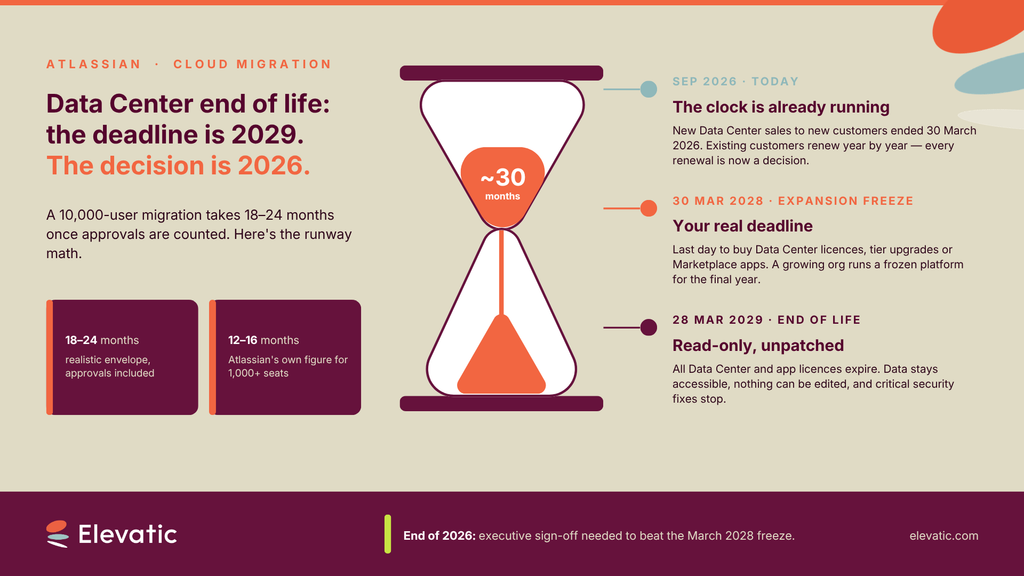
For a growing organization, the second date is the binding constraint. A company that acquires a subsidiary, onboards a new business unit or simply grows headcount in mid-2028 will not be able to license those users on Data Center. You’ll be running a frozen platform for the final twelve months — or running two platforms at once. That is why the working deadline for most enterprises is March 2028, not March 2029.
Bitbucket Data Center is the exception: it is not being end-of-lifed, and existing customers receive a hybrid license covering both Data Center and Cloud. Jira Align Data Center is also excluded. Everything else — Jira, Jira Service Management, Confluence, Bamboo, Crowd — follows the dates above.
Do the runway math for a 10,000-user organization
Atlassian’s cloud transformation guide estimates that planning and executing a lift-and-shift migration takes around four months for up to 5,000 users, six months for 5,000–10,000 users, and 6+ months beyond that — with the explicit caveat that leadership buy-in and staffing can accelerate or decelerate the timeline. For the enterprise segment, Atlassian is more candid: the FastShift program is pitched as compressing migrations “from 12–16 months to just 2–6 months”, which tells you what Atlassian considers the normal duration for a 1,000+ seat organization working on its own.
Those figures cover the migration itself. They don’t include what comes before it, and in a large enterprise that’s where the time goes:
- Business case and budget approval. If your fiscal year starts in January, a program not funded in this autumn’s planning round waits twelve months for the next one.
- Security, compliance and data-residency review. Regulated industries typically need a formal cloud risk assessment, a data-residency decision (Atlassian offers pinning in the EU, Germany, Switzerland, the UK and other regions, but not every app follows) and legal sign-off.
- Marketplace app portfolio decisions. Every app needs a keep, replace or retire decision, and vendors need to confirm Cloud parity. We covered how to structure that in The Marketplace App Strategy Every Enterprise Needs.
- Procurement. Cloud Enterprise contracts, partner statements of work and app subscriptions all go through vendor onboarding.
Put together, 18–24 months from “we should look at this” to “we’re live on Cloud” is a realistic envelope for a 10,000-person organization. That’s not pessimism; it’s the sum of calendars you don’t control. Now count backward from today, September 2026:
Different scenarios
Scenario A — land before the expansion freeze (go-live by Q1 2028). That’s about 18 months away. It works only if executive sign-off and funding are in place by the end of 2026, the assessment starts in Q1 2027, and test migrations run in the second half of 2027. There is no slack for a delayed security review.
Scenario B — land before end of life with a safety buffer (go-live by Q3 2028). This leaves two quarters before 28 March 2029 for post-migration stabilization and any spaces or projects that need a second pass. Sign-off is needed by mid-2027 at the latest, and you accept twelve months on a frozen Data Center footprint.
Scenario C — sign-off slips into 2028. Your migration window shrinks to under twelve months for a program Atlassian itself sizes at 12–16. You are now dependent on FastShift eligibility (1,000+ commercial Cloud seats, an executive sponsor, readiness to migrate within 2–6 months, and commercial Cloud only — not Isolated or Government Cloud) or on a partner running a compressed, higher-risk cutover.
Whichever scenario you land in, the execution follows the same shape — our six-phase migration framework covers it — but settle the destination early: commercial Cloud, Isolated Cloud (generally available since mid-2026) or Government Cloud each have a different app catalog.
Understand what “running out of runway” actually means
Missing the deadline is not a soft landing. Based on Atlassian’s FAQ, the consequences arrive in this order:
- From April 2028: frozen headcount and frozen tooling. No new users, no tier upgrades, no new apps. Vendors have been unable to submit new Data Center apps since December 2025, so the ecosystem has already stopped growing.
- From April 2029: read-only. You can access your data but cannot create or edit anything. Ten thousand people lose their system of record for work overnight.
- From April 2029: no security fixes. Atlassian’s commitment to critical security patches ends with end of life, and Atlassian advises against keeping unpatched instances connected to the internet. A read-only Confluence full of contracts and architecture documents is still an attack surface.
- Extended maintenance is not a plan. Atlassian says it will offer multi-year extensions “by exception only” for customers with unique circumstances. No criteria are published. Building a roadmap on an exception you have not been granted is a governance risk your audit committee will want to know about.
Factor in the cost of waiting
Delay isn’t free, even before the deadline bites. Atlassian raised Data Center list prices in February 2025 by 15–25% depending on tier, and again in February 2026 by 15% across all tiers for Jira, Confluence and Jira Service Management. Multi-year Data Center renewals were withdrawn in 2025, so every renewal is now an annual event — and an annual price decision.
On the other side of the ledger, incentives also expire. Atlassian’s FAQ notes that customers purchasing Cloud Enterprise by June 2027 may be eligible for a 10–20% discount on their first year. Dual licensing and step-up credits for unused Data Center maintenance are available to soften parallel running. The Elevatic Migration Hub summarises the current programs. The point is not that Cloud is cheaper — see our TCO analysis for the nuances — but that the terms get worse the longer you wait.
Key Takeaway
Atlassian Data Center end-of-life is usually filed as a 2029 problem. For a large enterprise, it is a 2026 decision, because the expansion freeze in March 2028 is the real deadline, and the migration before it takes 18–24 months once you count approvals as well as engineering.
Treat the deadline as a fixed point and plan backward from it. Name the sponsor, pick your go-live quarter, and get the mandate into this year’s budget cycle. Organizations that do so will migrate on their own terms, with a test cycle and a buffer. Organizations that wait will migrate on Atlassian’s terms, compressed, and with less negotiating room every quarter.
Elevatic has supported enterprise Data Center to Cloud migrations for years, and our entire app portfolio is Cloud-ready and mostly Forge-based. The Elevatic Data Center to Cloud Migration Hub brings together a Data Center vs. Cloud feature-parity comparison for our apps and migration paths. If you’d like a second pair of eyes on your timeline, talk to our team.