

TL;DR
Most enterprise AI search uses retrieval-augmented generation (RAG): embed documents, retrieve nearest matches, give them to an LLM, and summarize. It works in demos but fails at scale because flat vector search ignores who wrote or owns content, who it’s relevant to, and who can view it. Knowledge graphs model relationships between people, work, and content — enabling permission-aware retrieval. Permission issues, more than model limits, explain why 93% of enterprises face governance/access problems and 81% have delayed or abandoned AI projects. This post explains where RAG fails, what knowledge graphs add, why permission-aware retrieval is crucial, and how things change when AI moves from answering to acting.
You ask your company’s AI assistant a simple question: “What’s our current policy on customer data retention?” It gives you a confident, well-written answer. It’s also wrong — from a draft policy three reorgs ago, sitting in a stale Confluence space nobody archived. Or worse: it’s right, but it just surfaced a compensation spreadsheet to someone who should never have seen it.
Both failures come from the same root cause. The AI can find text that sounds relevant. It has no idea what that text actually is within the organization, whether it’s authoritative or abandoned, current or superseded or visible to this specific person. That’s not a model problem. It’s an information-architecture problem. And it’s why so many enterprise AI search rollouts stall somewhere between the pilot and the company-wide launch.
This post covers four things worth understanding before you invest further in enterprise AI search.
- Why RAG alone hits a ceiling
- What knowledge graphs add that flat search structurally can’t
- Why permission-aware retrieval is the hardest and most underestimated part of the whole stack
- How the shift from generative to agentic AI changes what “search” even means.
Understand why “search then summarize” breaks down at scale
Retrieval-augmented generation is, at its core, a simple pipeline. Convert your documents into vector embeddings, retrieve the ones that are semantically closest to a query, and let an LLM summarize them into an answer. It’s a real improvement over keyword search, and it’s why RAG became the default architecture for enterprise AI search almost overnight.
The problem is that “semantically similar” and “actually correct” are different, and the gap between them widens with scale. A few specific failure modes show up consistently:
- No sense of authority or recency. Vector similarity can’t distinguish the current, owned, approved version of a document from an abandoned draft that uses similar language. Both retrieve equally well.
- No sense of relationships. RAG treats every document as an isolated island. It can’t answer “who on the platform team last touched this” or “which projects depend on this decision” because those aren’t captured in the text — they’re captured in how people, teams, and work items connect.
- Context gets flattened and diluted. Retrieving the “top K” chunks and stuffing them into a context window loses the surrounding structure. The difference between a top-level policy and a footnote exception disappears.
- Accuracy ceilings that don’t move with better prompting. Reported accuracy for standalone RAG systems on enterprise-scale question answering plateaus commonly around 70%, largely because the retrieval step itself, not the generation step, is the bottleneck.
None of this means RAG is broken as a technique. It means RAG alone is an incomplete answer to what enterprise search actually requires: understanding not just what a piece of content says, but where it fits in the organization.
Map relationships, not just documents
What a knowledge graph actually is
A knowledge graph is a structured representation of entities — people, teams, documents, projects, decisions — and the relationships between them: authored by, owned by, supersedes, depends on, reviewed by, relevant to this team. Where RAG asks “what text is similar to this query,” a knowledge graph asks “how does this piece of information relate to everything else, and who does that make it relevant, or accessible to?”
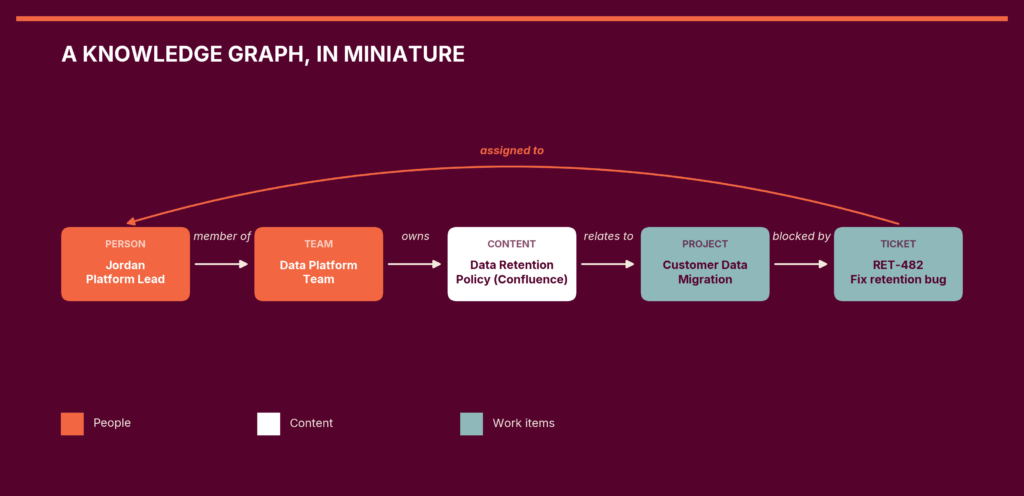
A five-node example makes this concrete: a person is a member of a team, that team owns a policy document, the document relates to a migration project, the project is blocked by a ticket, and the ticket is assigned to the same person it started with. None of those connections live in the text of any single document — they only exist because the graph models the organization around the content, not just the content itself. That’s a layer flat vector search can’t represent.
The proof: GraphRAG outperforms flat retrieval
This distinction is why combining graph structure with retrieval (often called GraphRAG) is outperforming flat RAG on real enterprise workloads. LinkedIn’s own production deployment of RAG plus a knowledge graph for customer service improved answer accuracy by 78% and cut median resolution time by 29%, according to reporting on the rollout. Microsoft Research’s own GraphRAG work found that the graph-based approach required up to 97% fewer tokens than standard RAG while producing more comprehensive answers — because the graph already encodes the structure that flat retrieval has to rediscover, expensively, at query time.
Atlassian’s Teamwork Graph as a working example
Atlassian’s own approach is a useful, concrete example for anyone running on Confluence or Jira. The Teamwork Graph unifies work data across Atlassian products and roughly 100 third-party apps, then “intelligently maps data to learn who you are, what you do, and how you do it” — building the connective layer that lets Rovo’s AI features understand organizational context, not just document content. That’s the graph doing what vector search structurally cannot: turning a pile of pages and tickets into a map of who owns what, who’s involved, and how pieces of work relate.
The catch is that knowledge graphs are genuinely harder to build and maintain than a vector index — Gartner placed GraphRAG on its Hype Cycle with an estimated two-to-five years to mainstream maturity. The organizations getting value now aren’t the ones with the most sophisticated graph technology; they’re the ones with clean, well-structured source content and clear ownership to map in the first place. Graph technology amplifies structure that already exists — it doesn’t invent it from a mess.
Solve permissions before you solve search
The real failure mode isn’t the model
Here’s the failure mode that actually stalls most enterprise AI rollouts, and it has nothing to do with model quality: making sure the AI never surfaces something a given user isn’t entitled to see. This sounds like a solved problem — “just check permissions before returning results” — but at enterprise scale it’s genuinely hard.
Why permission-aware retrieval is hard at scale
- Permissions have to be checked at query time, not index time. Access changes constantly (role changes, offboarding, project reassignment); a system that only respects permissions as they stood when content was indexed will leak stale access.
- Permission logic differs per source. Confluence space permissions, Jira project roles, and third-party app ACLs don’t share a model — a unified AI layer has to reconcile all of them correctly, every time, without a performance-killing check-per-document at scale.
- Over-sharing is already the default in most environments, long before AI enters the picture — which means an AI search layer built on top of existing permissions inherits and can amplify years of accumulated access sprawl.
- Governance and enforcement live in different systems. Recent research found that 93% of enterprises hit permission or governance issues during AI implementation, that only 15% have all four foundational AI governance capabilities fully operational, and that teams spend roughly 77% of AI project engineering hours on governance workarounds and access-control repair rather than building features. A separate analysis of enterprise AI access patterns found that a large share of AI-to-data connections were happening outside identity management oversight entirely.
What “permission-aware” should actually mean
This is exactly why “you’ll only see what you have access to” has to be a first-class design principle, not an afterthought bolted onto search. Atlassian’s own Rovo Search documentation states this almost verbatim: results are returned “only from content the current user has access to,” enforced consistently across Confluence, Jira, and connected third-party sources — and even Atlassian flags rare edge cases (like previously-viewed content surfacing after access is revoked) as things to actively guard against. If a vendor with that level of platform control still calls out the edge cases, it’s a fair signal of how unforgiving this problem is for anyone building it from scratch.
Evaluate vendors on this, not just answer quality
Before evaluating any enterprise AI search tool on answer quality, evaluate it on how it handles permission inheritance, real-time revocation, and cross-source ACL reconciliation. It’s the least glamorous part of the stack and the one most likely to stall your rollout in security review.
Move from systems that answer to systems that act
The last shift worth naming explicitly is that generative AI and agentic AI solve different problems, and conflating them leads teams to expect the wrong outcomes from enterprise search investments.
Generative AI creates. Give it a prompt, and it produces text, a summary, a draft — reactively, waiting for a person to ask. Agentic AI acts. It’s goal-oriented, connects to systems via APIs and workflows, and can initiate a sequence of steps toward an outcome without a human prompting each step — monitoring conditions and executing multi-step processes proactively rather than just responding to a question.
Applied to enterprise search, this is the difference between:
- A generative system that answers “what’s the status of the migration project” by summarizing whatever documents it retrieved.
- An agentic system that, understanding the relationships in a knowledge graph (this project, its owner, its dependent tickets, its current blockers) and respecting permission boundaries for who’s asking, can actually update the status, notify the right owner, or kick off the next step in the workflow.
The second is only possible once the first two problems—relationship-aware context and permission-aware retrieval—are solved. An agent that acts on bad context acts on bad information faster and with more consequence than a chatbot that merely answers with it. This is the real argument for building the graph and the permissions layer properly now: it’s the foundation for every future agentic capability, not just a nicer search box.
Key Takeaway
Enterprise AI search doesn’t fail because the underlying models aren’t good enough. It fails because flat retrieval lacks concepts of relationships, authority, or access — and bolting an LLM onto a vector index doesn’t create any of those things after the fact. Knowledge graphs matter because they encode the organizational structure — who owns what, how work connects and who it’s relevant to — that enables both accurate and safe retrieval. Permission-aware retrieval isn’t a compliance checkbox layered on top; it’s a hard technical problem that must be solved with the same rigor as retrieval itself, because it’s the actual reason most rollouts stall during security review rather than in the AI’s answer quality. Treat structure, relationships, and access as infrastructure to be built deliberately — not as details you’ll clean up after the AI is already live.
None of this starts with the AI layer, though. A knowledge graph — or an agent — can only be as good as the structure underneath it, and for most Atlassian-based organizations that structure lives in Confluence: spaces without clear ownership, pages with no consistent hierarchy, and permissions that have drifted for years. Elevatic’s Meridian Knowledge Structure for Confluence solution is built for exactly this groundwork — clean information architecture, clear ownership, and content that’s actually structured well enough for any AI layer, graph-based or otherwise, to reason about safely. If you’re evaluating enterprise AI search and want your Confluence content ready for it, book a demo with the Elevatic team.